
Maritime Jobs in the UAE: How to Get Noticed by the Right Companies
From yachting and marine engineering to shipping, logistics and shore-based roles, the UAE maritime sector offers a wide range of career opportunities. For professionals, the challenge is getting in front of the right companies. For employers, it is finding people with the right experience when they need them.
30 Sep 2026
The UAE Maritime Job Market Is Bigger Than Many People Realise
Searching for maritime jobs in the UAE can give the impression that the industry is mainly made up of ship crews, yacht crews and marine engineers. In reality, the employment market is considerably broader. The UAE Ministry of Energy and Infrastructure says around 27,000 maritime companies operate in the country, with the wider maritime sector contributing more than AED 135 billion to national GDP.
That industry stretches across commercial shipping, ports, logistics, offshore operations, shipbuilding, yacht management, charter, brokerage, marinas, engineering, marine equipment and dozens of specialist services. Each part of it needs people, and not every role requires years at sea or a technical qualification. Shore-based positions in operations, sales, procurement, finance, marketing, administration and business development all form part of the same maritime economy.
This is what makes the UAE such an interesting market for maritime professionals. A career in the sector does not necessarily begin onboard a vessel, and it certainly does not have to stay there.
Where Are the Maritime Jobs in the UAE?
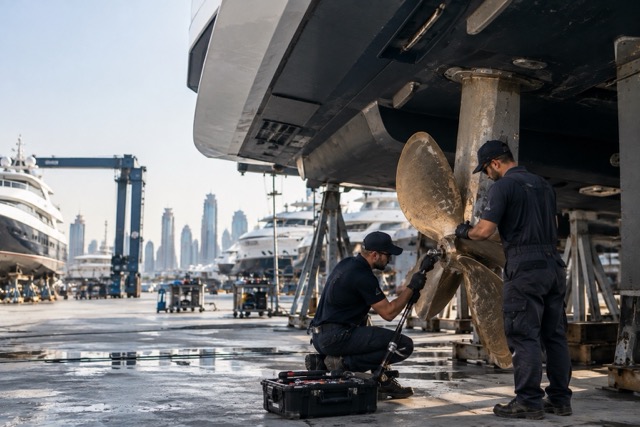
Dubai and Abu Dhabi account for a large share of marine jobs in the UAE, but opportunities exist across the country. Commercial shipping and logistics businesses recruit across vessel operations, chartering, shipbroking, freight, agency services and fleet management, while ports and terminal operators need operational, technical, safety and commercial teams. Shipyards and engineering companies add demand for technicians, project managers, surveyors and specialists across mechanical, electrical and structural work.
The leisure marine sector has its own employment market. Yacht jobs in the UAE include captains, deckhands and interior crew, but they also extend to yacht managers, charter managers, brokers, sales professionals and shore-side operations teams. Marinas, watersports companies, yacht service businesses and equipment suppliers create another layer of jobs that sit around the vessels themselves.
For anyone considering marine careers in the UAE, the first step is understanding where their experience fits. The market is large, but the roles are spread across very different parts of the industry, and each one looks for a different combination of skills and background.
Finding Vacancies Is Only Half the Job Search
Most professionals approach a job search in the same way. They open LinkedIn, Indeed or another job board, search for relevant roles and start applying. There is nothing wrong with that, but it only gives access to opportunities that have already been advertised.
Maritime recruitment does not always work that neatly. Companies hire through their own networks, recommendations, recruitment agencies, direct approaches and existing industry contacts. Smaller marine businesses in particular may begin looking for someone before they have created a formal job advertisement, while specialist roles are often filled through people already known within the market.
Professionals looking for maritime jobs in Dubai, Abu Dhabi or elsewhere in the UAE should still monitor vacancies, but they also need to think about how visible they are to the maritime companies they want to work for.
For Professionals: Make Yourself Easier to Find
A strong job search should work in both directions. You should be able to find companies, but companies should also be able to find you. That matters even more in specialist industries where an employer may be searching for someone with yacht charter experience, marine engineering knowledge, shipyard project experience or a particular maritime certification.
Your professional profile needs to make that experience obvious. Calling yourself an "Operations Professional" tells a marine employer very little, while "Yacht Operations Coordinator", "Marine Engineer" or "Shipping Operations Executive" provides immediate context. The same applies to your experience. Explaining what vessels, projects, clients or areas of the maritime industry you have worked with is far more useful than relying on generic descriptions of your responsibilities.
The aim is not to make your profile longer. It is to make it easier for someone in the industry to understand where you fit, what you know and why your background may be relevant to their business.
What Maritime Companies Actually Need to See
A maritime employer viewing your profile usually wants to answer a few questions quickly. What do you do, what experience do you have, where are you based, which part of the industry do you understand, and do you hold the qualifications or certifications required for the role?
Your CV remains important, but it should not be the only place where that information exists. A clear professional profile allows an employer to understand your background before opening an attachment, while relevant certifications, specialist skills and previous positions can immediately separate you from candidates whose experience is less relevant.
Availability also matters. Someone actively looking for work is in a different position from an experienced professional who is employed but open to the right opportunity. Giving companies enough context to understand your current situation, along with keeping technical qualifications and certifications up to date, makes the first conversation much easier.
You Don't Have to Work at Sea to Have a Maritime Career
One of the biggest misconceptions around maritime employment is that you need to work onboard a vessel. The UAE's maritime economy supports a large shore-side workforce across shipping, yacht management, marine supply, logistics, brokerage, finance, HR, insurance, marketing, procurement and business development.
That creates opportunities for people moving into the sector from other industries. Someone with strong B2B sales experience may be relevant to a marine equipment supplier, while a logistics professional may be able to move into shipping operations. A marketer with experience in luxury or hospitality may fit naturally into a yacht brokerage or charter business.
Industry knowledge still matters, and technical positions understandably require the appropriate qualifications. But not every marine job requires ten years at sea. For many shore-based roles, transferable skills combined with an understanding of the sector can be enough to open the door.
Experience at Sea Can Open Doors Ashore
The opposite transition is just as important. Captains, engineers, officers and other experienced seafarers often reach a point where they want to move ashore, and their experience can be highly valuable in yacht management, fleet operations, technical management, surveying, compliance, port operations and training.
The challenge is translating onboard experience into language that a shore-side employer can understand. Managing a vessel involves far more than navigation or engineering. Senior crew often have experience with budgets, contractors, maintenance programmes, safety procedures, crew management, procurement and regulatory compliance, all of which can transfer into shore-based roles.
The global shipping industry is also facing continued pressure around skilled personnel. The 2026 BIMCO and International Chamber of Shipping Seafarer Workforce Report estimates a global shortage of 39,100 STCW-certified officers and projects that another 113,735 officers will be needed by 2030. Those are global merchant-shipping figures rather than a measure of the UAE market, but they underline the wider competition for qualified maritime professionals.
For Employers: The Right Candidate May Not Have Applied
The recruitment problem looks very different from the company side. Posting a vacancy can generate applications, but quantity is rarely the real issue in specialist maritime recruitment. Relevance is.
A marine engineering company looking for an experienced technical manager does not need hundreds of unrelated CVs, and a yacht management business searching for someone with large-yacht experience has a very specific requirement. The same applies to shipbrokers, charter managers, captains, marine surveyors and many other specialist roles.
Good candidates may also already be working. They might not be checking job boards every day or actively applying for positions, but they could still be open to the right opportunity. That is why maritime recruitment in the UAE benefits from professional discovery as well as conventional vacancy advertising.
Maritime Hiring Is Not One Market
It is tempting to talk about marine recruitment in the UAE as though every maritime company is hiring from the same talent pool. They are not. A yacht charter company has very different needs from a commercial ship operator, while a marina is not recruiting the same people as a shipyard.
Even businesses operating in similar areas can require very different experience. A marine equipment distributor may need technical sales staff, while an engineering contractor could be searching for highly specialised technicians. An operations manager from a hotel and an operations manager from a marina may have overlapping skills, but their industry experience is fundamentally different.
For employers, understanding that context matters. Job titles alone do not always tell the complete story, which is why reviewing a candidate's actual maritime background can save time and improve the quality of the first conversation.
Searchable Professional Profiles Can Reduce the Noise
Traditional recruitment usually begins with a vacancy. The company writes the job description, publishes it and waits for applications. A searchable professional network adds another route by allowing employers to see who is already working within the market before they decide how widely they need to advertise.
That does not replace job boards, recruiters or referrals. It complements them. A company can identify professionals with relevant experience, understand the available talent pool and approach people whose background already fits the role.
For professionals, the benefit is equally straightforward. Your profile remains visible even when you are not actively applying for a specific vacancy. In a specialist market where experience, qualifications and industry knowledge matter, that can create opportunities that would never appear through a normal application process.
Build Your Maritime Presence Before You Need It
The best time to establish your professional presence is not the day you urgently need a new job. Keeping your experience, CV and qualifications current means you are ready when the right opportunity appears and gives employers a clearer picture of your background before they make contact.
The same principle applies to companies. If your first attempt to understand the available talent market happens after an employee resigns, recruitment immediately becomes reactive. Knowing where to find relevant professionals before you need them makes hiring considerably easier.
Maritime careers are often built over years rather than individual applications. Relationships, reputation and visibility all play a part, and being easier to find is part of that process.
YachtWize Careers: Connecting Maritime Professionals and Companies
Yachtwize Careers has been built around both sides of the UAE maritime industry. For professionals, it provides a place to create a dedicated maritime profile, add work experience, skills and a CV, and make that information available to companies looking for people within the sector.
Whether your background is in yachting, commercial shipping, marine engineering, logistics, shipyards, marinas or another maritime field, the aim is simple: make it easier for the right company to discover what you can do. Instead of relying only on job applications, your profile becomes another way for relevant employers to find you.
For companies, Yachtwize provides access to professionals whose profiles are already built around the maritime market. Employers can identify relevant people alongside using job advertisements, their own networks and other recruitment channels, creating a more direct connection between the businesses operating across the UAE and the professionals behind them.
Subscribe to our newsletter
Get the latest yachting news, events, and company spotlights delivered to your inbox.